Why VAPT Is the Most Critical Investment Your Business Can Make in Cybersecurity Today
In an era where a single data breach can cost an organisation an average of USD 4.88 the highest recorded figure to date, per IBM's Cost of a Data Breach Report the question is no longer whether your business needs cybersecurity. The question is whether your current cybersecurity posture is genuinely robust, or merely an illusion of protection.
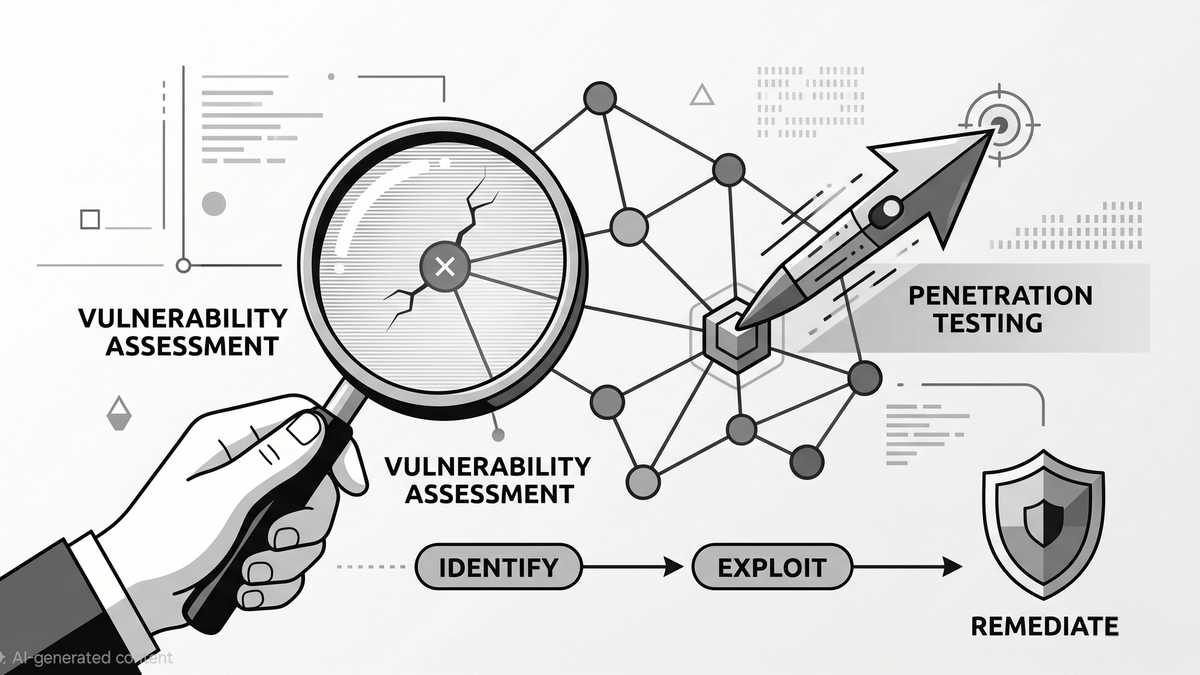
Vulnerability Assessment and Penetration Testing (VAPT) is the gold standard answer to that question. It is the most rigorous, structured method available to identify, validate, and remediate security weaknesses before malicious actors exploit them. Yet many organisations treat VAPT as a checkbox exercise rather than a strategic security a costly misconception that leaves them exposed.
This post demystifies VAPT, explains why it matters more than ever, and outlines what a truly effective VAPT engagement should deliver for your organisation.
The Business Case for VAPT in 2025 and Beyond
Cybersecurity threats are no longer confined to large enterprises or heavily regulated industries. Small and mid-sized businesses, healthcare providers, fintech firms, e-commerce platforms, and even government-adjacent entities are prime targets precisely because attackers perceive them as under-defended. Consider the following:
- 43% of cyberattacks target small and medium-sized businesses (Verizon DBIR)
- The average time to identify and contain a breach is 258 nearly nine months of undetected exposure
- Ransomware attacks increased by over 68% year-on-year, with median ransom demands exceeding USD 1.5 million in 2024
- Regulatory frameworks including DPDP Act (India), GDPR (EU), PCI-DSS, ISO 27001, and RBI cybersecurity guidelines now either mandate or strongly recommend periodic VAPT assessments
In this environment, VAPT transitions from a technical nicety to a board-level risk management imperative.
Types of VAPT Engagements: Choosing the Right Scope
A mature VAPT programme addresses multiple attack surfaces across your digital estate. Leading VAPT providers offer specialised testing across the following domains:
- Network VAPT: Evaluates external and internal network firewalls, routers, switches, servers, and for misconfigurations, unpatched vulnerabilities, and lateral movement risks.
- Web Application VAPT: Tests web applications against the OWASP Top 10 and beyond, covering injection flaws, broken authentication, IDOR, insecure APIs, and business logic vulnerabilities.
- Mobile Application VAPT: Assesses Android and iOS applications for client-side vulnerabilities, insecure data storage, improper session management, and API exposure.
- API Security Testing: Specifically targets REST, SOAP, and GraphQL APIs that are increasingly the primary attack vector in modern application architectures.
- Cloud Security Assessment: Reviews cloud configurations (AWS, Azure, GCP) for misconfigurations, excessive permissions, exposed storage buckets, and identity and access management weaknesses.
- Social Engineering & Phishing Simulations: Tests the human layer of your security posture through simulated phishing, vishing, and pretexting campaigns.
- Red Team Exercises: Advanced, scenario-based adversarial simulations that test your organisation's detection and response capabilities against a sophisticated, persistent threat actor.
The VAPT Methodology: What a Rigorous Engagement Looks Like
Not all VAPT engagements are created equal. A comprehensive, high-quality VAPT follows a structured methodology aligned with globally recognised frameworks including OWASP, PTES (Penetration Testing Execution Standard), NIST SP 800-115, and OSSTMM. The key phases include:
- Scoping & Rules of Engagement: Define the precise boundaries, objectives, testing windows, and escalation protocols to ensure zero disruption to live operations.
- Reconnaissance & Information Gathering: Passive and active intelligence collection on targets, mimicking the initial steps of a real attacker.
- Vulnerability Identification: Automated scanning augmented by expert manual testing to surface both known and zero-day-class vulnerabilities.
- Exploitation & Post-Exploitation: Controlled attempts to exploit findings, escalate privileges, move laterally, and reach sensitive data or critical systems.
- Reporting & Debriefing: Delivery of a detailed, risk-rated report with executive summary, technical findings, proof-of-concept evidence, and a prioritised remediation roadmap.
- Remediation Support & Retest: Guidance during the fix phase, followed by a retest to validate that all critical and high-severity findings have been effectively resolved.
A VAPT engagement without a formal retest is an incomplete engagement. Remediation validation is not it is the proof that your investment has delivered measurable security improvement.
What Separates a Superior VAPT Partner from the Rest
The VAPT market is crowded, and the difference between a compliance-grade report and a genuinely actionable security engagement is significant. When evaluating VAPT providers, organisations should look for:
- Certified expertise: Testers holding credentials such as OSCP, CEH, GPEN, GWAPT, CREST, or equivalent demonstrate validated, hands-on capability beyond tool-based scanning.
- Manual testing depth: Over-reliance on automated scanners produces noisy, incomplete results. Superior engagements combine tools with deep manual testing to uncover logic flaws and context-specific vulnerabilities that no scanner can detect.
- Business-context reporting: Reports must translate technical findings into business risk the likelihood of exploitation, potential business impact, and prioritised remediation steps that align with your operational reality.
- Regulatory alignment: Your VAPT provider should understand the specific compliance requirements of your whether that is RBI/SEBI guidelines, IRDAI circulars, PCI-DSS, ISO 27001, or the DPDP and ensure that testing scope and reporting satisfy those mandates.
- Ongoing partnership: The most value-driven VAPT engagements are not one-time events. A strategic VAPT partner works with you over tracking your security maturity, adapting to your evolving threat landscape, and helping you build a programme that continuously improves.
VAPT and Regulatory Compliance: A Dual Return on Investment
Beyond the direct security benefits, VAPT delivers a compelling compliance dividend. Organisations subject to regulatory oversight in India and globally are increasingly expected to demonstrate proactive security testing as evidence of due diligence. A well-documented VAPT with scoped assessments, remediation tracking, and retest provides:
- Audit trail evidence for ISO 27001 surveillance audits and certification renewals
- Compliance artefacts for RBI IT Framework, SEBI Cybersecurity and Cyber Resilience Framework, and IRDAI guidelines
- PCI-DSS requirement 11.3 fulfilment for entities handling cardholder data
- Demonstrable security controls under India's Digital Personal Data Protection (DPDP) Act obligations
- Cyber insurance premium insurers increasingly factor VAPT history into risk assessments and premium calculations
How Frequently Should You Conduct VAPT?
Frequency should be driven by risk appetite, regulatory requirements, and the rate of change in your technology environment. As a general framework:
- At minimum annually: Full-scope VAPT for all critical systems and applications, regardless of industry
- Upon significant change: Any major infrastructure upgrade, new application deployment, cloud migration, or M&A integration should trigger a targeted VAPT
- Quarterly or continuous: High-risk banking, fintech, healthcare, critical benefit from quarterly assessments or continuous vulnerability management programmes
- Post-incident: Following any confirmed or suspected security incident, a VAPT helps determine the full scope of exposure and validates that remediation has been effective
Conclusion: Security Is Not a It Is a Process
Organisations that treat VAPT as a periodic compliance exercise will always be one step behind the adversary. Those that treat it as an ongoing strategic embedded in their development lifecycle, procurement processes, and risk management are the ones that detect threats before they become breaches, satisfy regulators before they issue notices, and preserve client trust before it is tested.
The question is not whether you can afford to invest in VAPT. Given the regulatory, reputational, and financial consequences of a breach, the question is whether you can afford not to.
Partner with a VAPT team that brings certified expertise, deep manual testing capability, and a genuine commitment to your security not just a report that passes audit. Talk to our cybersecurity specialists today.
Is Your Cooperative Bank RBI-Audit Ready?
Meet RBI's strict annual VAPT and IS Audit requirements. Access Board-ready reporting and rapid vulnerability remediation.