Navigating the SEBI CSCRF Audit: The Technical Executive’s Blueprint for Compliance Maturity

The landscape of cybersecurity regulation for the Indian securities market underwent a tectonic shift when the Securities and Exchange Board of India (SEBI) introduced the unified Cyber Security and Cyber Resilience Framework (CSCRF). Superseding a fragmented web of older circulars, CSCRF establishes a rigorous, standardized, and graded compliance mechanism for all SEBI Regulated Entities (REs)—ranging from Market Infrastructure Institutions (MIIs) to Alternative Investment Funds (AIFs) and Stock Brokers.
For C-suite executives, directors, and CISOs, a CSCRF audit is no longer a superficial check-the-box routine. Non-compliance invites massive regulatory penalties, but worse, an un-resilient architecture risks catastrophic data exfiltration and market disruption.
The 6-Hour Rule: Under CSCRF, any cyber attack or critical security incident must be formally reported to SEBI and CERT-In within six hours of detection. Furthermore, a critical system disruption must be declared a 'Disaster' within 30 minutes.
Graded Categorization: Where Does Your Entity Stand?
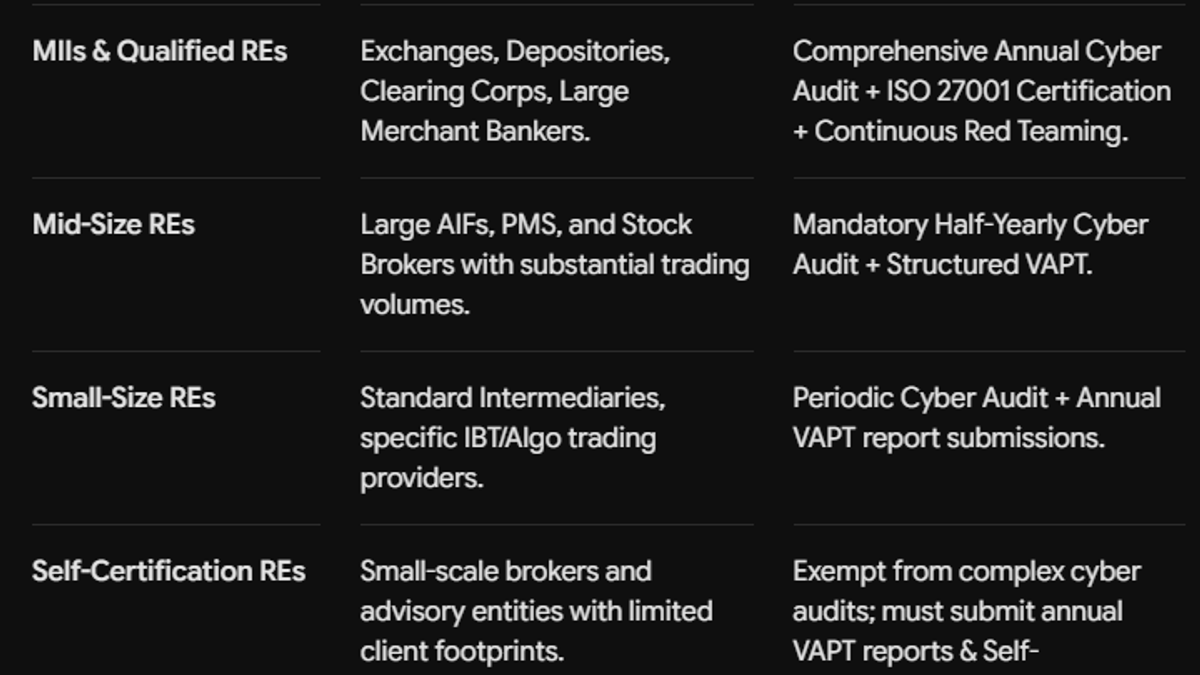
SEBI recognizes that a single-size framework cannot fit a diverse financial ecosystem. CSCRF divides REs into a graded tier structure based on asset under management (AUM), client count, and trade volume. Your specific audit obligations scale directly with your classification:
Technical Blueprint of the CSCRF Audit Scope
A compliant CSCRF audit is exceptionally thorough, mandating a 360-degree evaluation of your technical ecosystem. The framework dictates that audits must cover 100% of critical systems and at least 25% of non-critical systems sampled on a rotating basis.
When preparing your systems for a formal CSCRF filing, Photon Security deep-dives into your infrastructure to evaluate your readiness against SEBI's core compliance domains:
1. Advanced Governance & Cyber Capability Index (CCI)
We evaluate the operational efficacy of your internal policies and verify your Cyber Capability Index (CCI) maturity rating. We ensure that localized setups perfectly align with SEBI's strict data sovereignty expectations—ensuring no cryptographic key management or regulated data leaves Indian jurisdiction.
2. Robust Identification & Data Classification
We audit your Asset Management systems to confirm precise tagging of critical vs. non-critical assets. Our team reviews your automated inventory pipelines and validates your data localization protocols against the current Digital Personal Data Protection (DPDP) standards.
3. Proactive Protection & Patch Management
We deep-dive into your identity access management (IAM), multi-factor authentication (MFA) deployments, and end-to-end encryption states (both at rest and in transit). We also review the enforcement of your mandatory Software Bill of Materials (SBOM) to mitigate open-source supply chain risks.
4. Detection, SOC Efficacy, & VAPT Remediation
We don't just check if you have a Security Operations Center (SOC); we test its real-world defensive resilience. Our team conducts manual, adversarial Vulnerability Assessment and Penetration Testing (VAPT) across internet-facing apps, API endpoints, and peripheral network linkages to challenge your SOC's detection algorithms.
5. Incident Response & Recovery (BCDR)
We scrutinize your Business Continuity and Disaster Recovery plans through strict tabletop simulations. We audit your immutable backup strategies, ransomware containment playbooks, and the technical mechanisms built to execute recovery objectives under severe operational stress.
The Pre-Audit Trap: Why Heading Straight to a CERT-In Auditor Fails
Many financial firms make the mistake of hiring a CERT-In empanelled auditor right out of the gate without preparing their infrastructure first. When the formal audit begins, the auditor logs dozens of open vulnerabilities, configuration errors, and logic flaws in the final report. This leaves the entity with a permanent regulatory paper trail of security failures and an aggressive, stressful 30-day window to patch everything before re-testing.
Photon Security eliminates this risk. We act as your pre-audit engineering partner. We locate the vulnerabilities, clean up your architecture, and provide the technical remediation before the formal audit begins. When the final auditor steps in, your systems are locked down, secure, and ready to pass seamlessly.
Secure Market Integrity with Photon Security
Photon Security delivers elite, offensive-security-driven technical preparation engineered specifically for the Indian securities market. We bridge the gap between complex regulatory mandates and bulletproof enterprise defense.
- Elite Technical Specialists: Our engineers hold top-tier offensive security credentials (OSCP, CISA, CISSP) with years of experience hardening market infrastructure components.
- Pre-Audit Vulnerability Clean-up: You receive clear, prioritized technical playbooks designed to eliminate risk and fix code-level vulnerabilities before they hit an auditor's formal report.
- Seamless Auditor Alignment: We provide comprehensive documentation, configurations, and clean VAPT data that your final empanelled auditor can easily verify, slashing your audit friction in half.
Ensure Bulletproof Compliance Before Your Next Deadline
Do not leave your compliance maturity or market reputation to chance. Align your cybersecurity posture with SEBI’s rigorous expectations today.
- For Graded Scoping & Custom Compliance Roadmaps: Connect with our advisory team at sales@photonsecurity.com to determine your precise RE category requirements and audit cycles.
- To Schedule a Comprehensive Pre-Audit VAPT Assessment: Contact our engineering division directly at audit@photonsecurity.com to identify and patch system flaws before your formal compliance deadline.
Ensure SEBI CSCRF Compliance Before the Deadline
Our certified security auditors hold OSCP, CISA, and CISSP credentials to deliver end-to-end CSCRF audits, gap analysis, and VAPT testing.